Conwy: “A Castle of Matchless Magnificence"
- Aug 12, 2022
- 8 min read
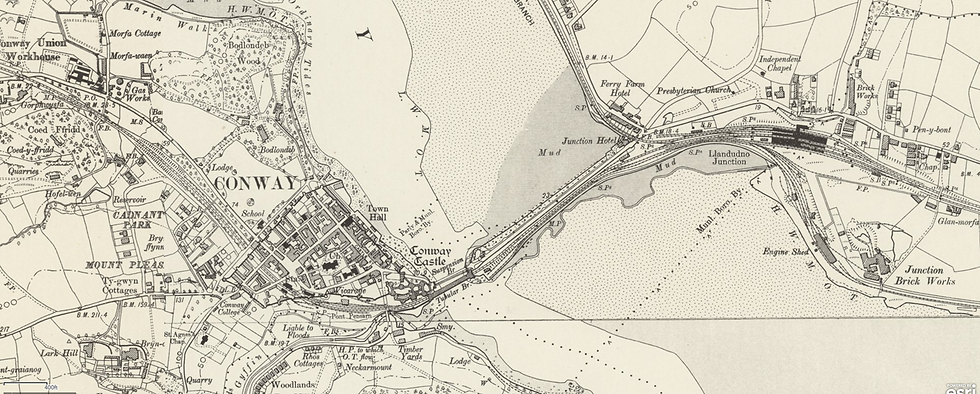
Location: Situated in Conwy, North Wales, at the mouth of the river Conwy
Constructed: Built by Edward I over a four year period, commencing in 1283, the castle and town occupy the site of Llywelyn the Great’s palace and Aberconwy Abbey.
Fancy visiting? Open 7 days a week, managed by CADW, admission charges apply
What’s in a name?
Coincidentally, my surname is Conway. One question I am asked often is whether I have any ancestral links to one of the main castles in my thesis.
‘Conway’ was the prominent spelling of the town’s name in English for centuries. My Conway line, however, is Irish not Welsh. Now, I adore genealogy – I did work for Ancestry, it’s a job requirement! Researching my families past has led to some very cool finds, not least that I’m a relative of Robbie Burns and my partner is the x15 (or is it x16?) g-grandson of Sir Thomas More.
Unfortunately, I cannot confidently trace the Conway branch back that far. There is the Earl of Conway whose family had close ties to Ireland, the 1st Earl wrecked my beloved castle and died without an heir - if there is a distant connection, I'm not eager to find it!
My ancestors, who spent the 19th century as hard-working Dublin labourers, are more realistically descendants of the medieval people ‘of Conway’ who somehow ended up in Ireland, or alternatively my surname comes from an anglicized name, such as ‘Mac Connbhuidhe’ (which means ‘headsmasher’!! apparently).
Now that's cleared up… time for one of my favourite castles!

Black’s Picturesque Guide to… Conwy
“Conwy Castle, erected in 1284 by Edward I., as a security against Welsh insurrection… When in its perfect state, this castle must have been one of the most magnificent fortresses of Britain. Pennant says, “one more beautiful never arose.”
“The great hall was 130 feet long, 30 feet wide, and 20 feet high… the roof was supported by eight massive arches, four of which remain, overgrown with ivy. Edward, accompanied by his constort Eleanor, and attended by many English nobles, spent a Christmas here, indulging in all the festivities of a luxurious court.”
“The castle was taken by the Parliamentary forces under General Mytton in 1646. In 1665, Edward, Earl of Conway, to whom a grant of it had been made after the Restoration, dismantled this beautiful fortress in a barbarous manner, and caused the timber iron, lead, and other movable materials to be transported to Ireland for the repair of his own property in that Kingdom.”
“This fortress has been made the scene of Lewis’s Drama “The Castle Spectre,” and of Gray’s well-known ode “The Bard.” The ruin is the property of the crown, and is held at a nominal rent by the Dowager Lady Erskine.” [1]
Words are not enough...
There is many different avenues I could explore here… and I’m certain Conwy will be a ‘case study revisited’ before too long. For now, I’m going to offer a taster of small aspects of my research into tourism in Conwy – namely - Conwy’s appeal, reactions to the railway, and preservation concerns.

You’d be hard pressed to find a town in Wales, or even in Britain, that captured the romantic imagination of late 18th and early 19th century travellers quite like Conwy did. Picturesquely situated upon the banks of a river with the same name and the mountainous landscape of Snowdonia beyond it, Conwy was completely enclosed in its medieval walls which contained a castle, a church and people occupied by agricultural and fishing industry – a medieval escape in an increasingly modern world.
Conwy Castle is one of those striking medieval buildings that appears so suddenly as you approach it makes you double take in awe. Its elevated position means that unlike many historic ruins it is not sheltered by buildings or trees, its entire form is visible in that first glimpse. Tintern Abbey in Monmouthshire has the same effect… hopefully if you have visited lots of medieval ruins you will know what I mean – I’d be keen to hear your examples!
Obviously, the fortress is no longer dripping with ivy and bridges constructed over the river have altered the landscape and changed how we experience that first sight of the ruin, but this first impression of Conwy Castle has endured for hundreds of years.
Expectations were high…
Travel writer, Louise Stuart Costello wrote on her 1845 tour:
“We had heard much of the boast of North Wales and the peculiar pride of the vicinity, the fine old castle, and the new suspension bridge, of Conway, and on our arrival there, far from considering that too much had been said, I think no description, however enthusiastic, can do justice to one of the most romantic and interesting spots that exists perhaps in Europe.”[2]
Similarly two years later, fellow travel writer, Charles Frederick Cliffe details his first view:
“Novel and impressive. We slowly approached it from Bangor, just after sunset on a summer evening. Before us stretched a walled town, with a grim range of circular bastions and ramparts, which in the fading light appeared almost as perfect as when raised in the thirteenth century. Not a sign of suburb without – not a sound broke the illusion, An Edwardian town of the middle age!
The magical effect of this great ruin cannot be learnt by description, but to be understood must be felt on the spot.”[3]
So… Conwy Castle had to be seen in person to be understood – words and paintings could not capture it – quite the advertisement, don’t you think?
Add to the mix that Conwy was also a “perfect specimen of a medieval fortified town, which, from the outskirts, realized an illumination of the chronicles of Froissart,” in which “a spectator could almost imagine himself transferred into a city of the Middle Ages,” as the diary of J.O.Halliwell records.[4]
Here the Middle Ages could not only be studied, but actually experienced.
Well… that is until modernity arrived…
Are we there yet?
Travelling to Conwy at the start of the century could be perilous. The hours long journey across the river on a ferry boat could be horrendous, with many travellers grateful they survived, some were less fortunate.

This treacherous journey ceased in 1826 with the construction of Thomas Telford’s Suspension Bridge (which is anchored to the castle!). Often described as a ‘drawbridge,’ Telford’s structure enabled safe and faster passage of the river and was exceedingly well received… the same cannot be said of the Robert Stephenson’s Tubular Railways Bridge which opened in 1849.
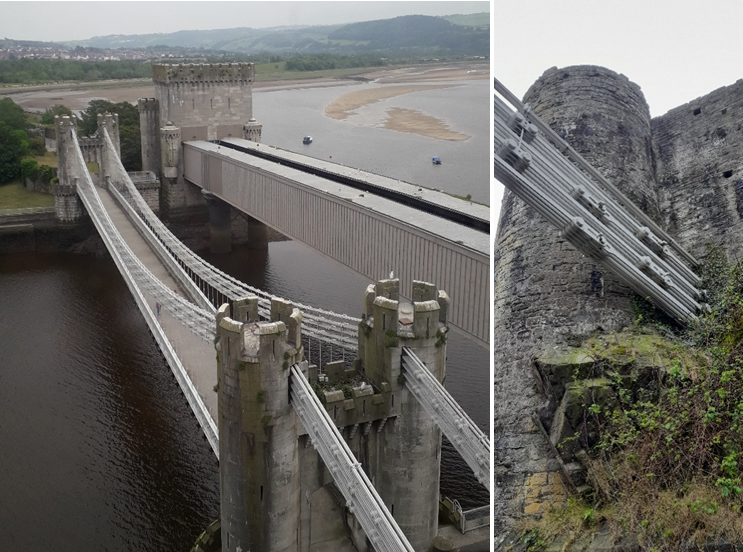
On a return trip, Halliwell is less than pleased with what he finds:
“As the place has improved in material wealth, this bit of sentimentality is ruined. The walls are still there, but the effect of the whole is marred by the new buildings, especially by those outside the boundaries; while the screaming railway engine, darting forth from that detestable-looking tubular bridge through an ancient fortification, with which its accessories have been formed with ill success to assimilate, renders all incongruous “Crabbed age and youth cannot live together.”
Railways don’t get on at all with antiquities. Who would care for Stonehenge if it were placed in the courtyard of a railway station?”

But… not all were critical of Conwy’s increasing industry. After all, the railway was cheap and efficient which enabled greater social movement bringing prosperity to the Welsh coast. The above image is a screenshot from a 'Phantom Train Ride' film shot in Feb 1898!! I highly recommend watching it:
Fascinatingly, the 1850 summer edition of Archaeologia Cambrensis included a letter to the editor from ‘a lover of improvement’ which not only praised Conwy’s railway network but suggested “PLASTERING THE WALLS OF THE CASTLE” so they match the bridge…
“Gentlemen, - on going through Conway the other day, I was particularly struck with the neat appearance of the tubular bridge, and its charming stone-coloured tint, as compared with the dingy blackness of the castle and the town walls. By the way, the castle is only a mushroom (by which he means it had just sprung up rapidly). King Edward’s architect was a fool to Stephenson. Pray, gentlemen, would it not be much better to open a subscription for plastering the walls of the castle, or at least for whitewashing them to match the bridge?”[5]
Immediately I thought ‘nah, this guy cannot be serious, it must be some kind of sarcastic joke’… but then there was a reply in the autumn edition:
“Gentlemen, - I heartily concur with the sentiments expressed. He has, however, by some oversight, omitted to mention that matchless specimen of architectural elegance. Which Mr Stephenson has been considerate enough to place in juxtaposition with the dirty old walls of the castle, and which he no doubt erected there for the purpose of, in some measure, concealing them.
Mr Stephenson, in conformity with taste displayed in all his architectural efforts, has placed at the point where the railroad intersects those useless old walls.
I cannot, however, close this letter without expressing my gratitude to the corporation and other authorities of Beaumaris for their great exertions in the cause of improvement, and especially for the judgement and ability with which they have hidden that antique deformity, Beaumaris Castle, from the gaze… by the interpolation of those highly elegant rows of buildings.”[6]
I'm still convinced its irony, and actually that the members of Archaeologia Cambrensis were just messing about.
More digging to be done here.
Its tricky because preservation of historical monuments was important to Victorian antiquarians, visitors, and local people alike – but talking/writing about it is very very different from actually doing it. Conwy was adored for its picturesque crumbling ivy-draped nature. The decay of the ruin inspired reflection, particularly through using the decomposition of the fortress to illustrate power of past ages and people as finite – basically we are all going to die and be forgotten as our physical remains disappear into nothing… what a cheerful bunch!
Back to my point, Conwy was, at times, not only allowed to decay but this was willed on. At the start of the century the Banqueting Hall had almost all its arches that once supported the roof intact, now there is 1 left…

Following the collapse of one of these arches in 1869, ‘an antiquary’ writing to the Archaeologia Cambrensis was disgusted with the lack of preservation:
“I hope that the board of woods and forests, if it has the power, will inquire into this case of gross neglect on the part of those who are the lessees or grantees of the castle. It is too bad, that while Caernarfon Castle should be so well cared for by the adoption of a reasonable admission-tariff, under a vigilant deputy constable, this fine old ruin at Conway should be still left to the carelessness.”
And neglect of those who are supposed to be its guardians, and that an exorbitant scale of charges for admission should be kept up merely for the sake of the gate-keeper and his family. Utter neglect, and now destruction, are all that this let-alone system has produced; and it is high time that the crown should interfere.
It will probably be considered irreparable, and the old building will be left to its fate. The gate-keeper pockets not much more than £100 per annum. By his admission-fees; and it is much more gratifying to spend the money in building new sham castles, and to live in them, than to repair old ones.”[7]
This is not an isolated preservation complaint; I have found them throughout the century, written by various individuals and groups. Conwy’s preservation story really begins in the 1870s when the town corporation took over the ownership of the castle from Lady Erskine (whose family it had been in since at least the beginning of the century).
But that’s for another post…
Footnotes
[1] A & Ch. Black. Black’s Picturesque Guide to North Wales (Edinburgh, 1874). Internet Archive. Pp.42-46 https://archive.org/details/blackspicturesqu00edin/mode/2up [2] Louisa Stuart Costello. The Falls, Lakes, and mountains of North Wales. (London, 1845). Internet Archive. P.45 https://archive.org/details/in.ernet.dli.2015.41752
[3] Charles Frederick Cliffe. The book of North Wales. Scenery, antiquities, highways and byeways, lakes, streams, and railways. (London, 1850). P.136. Google Books. https://books.google.co.uk/books?id=-55PugEACAAJ&printsec=frontcover&source=gbs_ge_summary_r&cad=0#v=onepage&q&f=false
[4] J.O. Halliwell, esq, F.R.S. Notes of a Family Excursion in North Wales, taken chiefly from Rhyl, Abergele, Llandudno, and Bangor. London, 1860. (printed for the author). Pp.110-110. British Library, Historical Texts.
[5] ‘Conway.’ Archaeologia Cambrensis a record of the antiquities of wales and its marches and the journal of the Cambrian archaeological association. New series No.111 July 1850. Welsh Journals Online. National Library of Wales. P.230


Comments